Table of Contents
- Introduction of Panelists
- The Shift in Software Engineering: The Cost of Code Generation is Zero
- Advice for Aspiring Front-End Engineers in an AI World
- Engineering Precision vs. Trial and Error
- Learning React and the Self-Driving Analogy
- Future Predictions: Binary Compilation and Autonomous Agents
- The Challenges of AI in UI Design and Spec-Driven Development
- Conclusion
1. Introduction of Panelists
Perete Harrison: What’s up everyone? I’m Perete Harrison, a DevOps Software AI Engineer here with Atop Web Technologies. I have two of my colleagues here with me, Kehinde and Gideon, and they will introduce themselves.
Kehinde Adeyombo: Hello everyone. I’m Kehinde Adeyombo, a Front-End Web Development Engineer here at Atop Web Technologies. Nice to meet you.
Gideon Usani: Hi everyone, I’m Gideon Usani, a Front-End Engineer here at Atop Web Technologies.
Perete Harrison: This conversation is happening spontaneously to act as a roadmap for upcoming engineers—people who are learning front-end or back-end development. We want to use this session to produce insights that help the community build better with AI.
2. The Shift in Software Engineering: The Cost of Code Generation is Zero
Perete Harrison: AI has disrupted the entire software development industry. From my perspective—and as I recently shared online—the cost of generating code is falling to zero.
What still matters is your ability to reason through systems, security, architecture, and real-world business problems. This is where engineers will continue to create value. Today, if you can imagine it, you can generate the code. Natural language is becoming the new coding language. If you know how to express your intent clearly, generating code is cheap.
The best builders will still be those who understand:
- Software engineering architecture
- Security and APIs
- Databases
- CI/CD and deployment
Prompting is easy; reasoning through complex systems is the key. While I respect the engineering behind various coding agents, utilizing an advanced coding agent under proper human guidance yields insane results. Whatever I imagine, I can get done with security in mind.
3. Advice for Aspiring Front-End Engineers in an AI World
Perete Harrison: Kehinde, as a front-end development engineer, what is your advice for folks trying to get into front-end who want to be like you? Can you shed some light on how you started your journey versus how people should learn now using AI? Let’s be honest—everybody is using agents currently. Even Google has noted significant code commits coming from internal AI tools. What is your advice?
Kehinde Adeyombo: When I started learning to code, there was no public AI adoption. It was just YouTubers, blog posts, and documentation. It was definitely more difficult back then because you had to learn strictly by building projects manually.
That core principle is still preserved: you still need to build projects. But now it’s very easy to generate code, which introduces a new trap. Beginners can easily get lost in the specifics and lose focus on what they are actually trying to build.
At this point, you are more of an architect or a mini project manager. Think of it like construction: builders once had to move earth, lift materials, and perform countless tasks by hand. Modern machinery makes those jobs dramatically faster, but someone still has to read the plans, coordinate the work, and ensure the structure is sound. AI changes how software is built in much the same way—it reduces manual effort, but it does not eliminate the need for understanding, planning, and oversight.
As a modern developer, you are controlling something that builds for you. A tool is building a feature, but you must oversee it, check it, and understand it.
I advise beginners to:
- Start with smaller projects: Build things like scoped to-do applications.
- Do not blindly trust AI code: You shouldn’t trust anyone’s code without verification. Review it, understand it, and ask the AI to explain it to you. AI makes mistakes and won’t always know why it made them.
- Catch small mistakes early: Spotting patterns in smaller projects prepares you to identify larger architectural failures later on.
4. Engineering Precision vs. Trial and Error
Perete Harrison: Gideon, what is your advice for the next generation of engineers following this same premise?
Gideon Usani: I completely agree with Kehinde. There is a fundamental difference between someone who just writes code without understanding and an engineer who actually knows programming. It’s like the difference between a mechanic who does trial-and-error and a trained systems engineer.
A trial-and-error approach relies strictly on experience and guessing until something works. An engineer studies the system systematically to pinpoint exactly where the issue lies. Knowing your programming language deeply allows you to be precise, drastically reducing trial-and-error loops because you know where errors originate.
When you want to start a project, an experienced programmer can give highly precise technical directions to an AI, saying: “I want to use Next.js, Material UI, and Tailwind CSS.” You can guide it explicitly because you understand the tools. Someone who doesn’t know how to program will just say: “Build me a website.” They won’t be able to manage, scale, or maintain that codebase in the long run.
5. Learning React and the Self-Driving Analogy
Perete Harrison: Let’s talk about React. Historically, front-end development relied on tools like jQuery before React disrupted the ecosystem with component-based architecture. If someone wants to learn React today in this AI universe, what is your direct advice, Gideon?
Gideon Usani: I still think you need to know the foundation of everything you do. Just like you need to understand foundational HTML to be truly efficient at using React. I highly advise learning React alongside modern meta-frameworks like Next.js. They are the industry standards that most companies look for, which makes you highly valuable in the market. Your tool choice should always depend on what you are trying to achieve.
Regarding the AI element: think of it like a Tesla. Teslas have self-driving capabilities, but it is not advisable to completely forget how to drive. If something goes wrong with the automated system, you must be able to switch to manual controls immediately to maintain safety. It’s the exact same thing with programming frameworks—you must know how the underlying system works when the AI fails to achieve your goal.
6. Future Predictions: Binary Compilation and Autonomous Agents
Perete Harrison: What are your predictions for AI within the front-end ecosystem? AI is improving every single day because our active usage creates continuous feedback loops. I was watching an industry interview recently where it was predicted that high-level human programming languages might eventually become obsolete.
Right now, we write high-level code (like if/else statements and functions), which compilers and transpilers convert into machine binary. In the future, AI will likely bypass high-level syntax entirely and write optimized binary directly for computer execution.
From an AI engineering standpoint, we already see this with autonomous agents. Agents can reason, make decisions, execute actions, and self-correct.
I’ve been experimenting with agents that dynamically write code, execute it, and return the output on the fly without any hardcoded rules. For example, instead of pre-writing a rigid user registration and login flow, an agent can handle incoming registration requests autonomously on the fly without being tied to a specific language.
Imagine a universal system architecture under a domain like atopwebtechnology.com. When a client arrives, an autonomous agent interviews them about their business goals. If they need a robust authentication system or a web application to automate a physical workflow, the agent dynamically builds, tests, and serves that application on the fly. It’s like a car that automatically transforms into a flying vehicle when it encounters traffic—true dynamic reasoning.
Kehinde, what is your take on the future of front-end with this level of AI competency?
Kehinde Adeyombo: AI is incredibly competent now, but you cannot legitimately call yourself a developer if you are just blindly prompting a tool to build things you do not comprehend.
Consider this example: if a random person manages to fix a leaking pipe, that does not make them a plumber. They simply solved a localized problem in that specific moment. To be a developer, you must understand the underlying architecture of your application.
Fortunately, AI changes how deep you have to go initially. Previously, a React developer often had to spend significant time reading documentation for integral parts of the ecosystem. State management libraries like Redux, data-fetching tools like React Query, routing solutions, form libraries, testing frameworks, and build tools just to become productive Now, once you grasp core React principles, you can utilize AI to navigate and integrate secondary ecosystems much more comfortably.
7. The Challenges of AI in UI Design and Spec-Driven Development
Perete Harrison: What are the explicit challenges you face right now when using AI to construct user interfaces?
Kehinde Adeyombo: When you have highly specific visual designs or structural specifications, AI frequently fails to follow them precisely. It consistently takes creative liberties. You can specify exact padding values or border constraints, and it will still alter elements arbitrarily.
Furthermore, AI suffers from scope creep. If you ask it to build a specific layout or a landing page, it will often start adding unrequested sections. If it takes those liberties with UI layout, it will do the same with core logic. You might write a form component meant to route data to a specific endpoint, and the AI will decide to send that data elsewhere because it “thinks” that makes sense structurally. That is a recipe for architectural disaster if you don’t monitor it.
Perete Harrison: That happens because AI models are fundamentally probabilistic, not deterministic. If you ask an AI to write the exact same function twice, you will receive different variations of code.
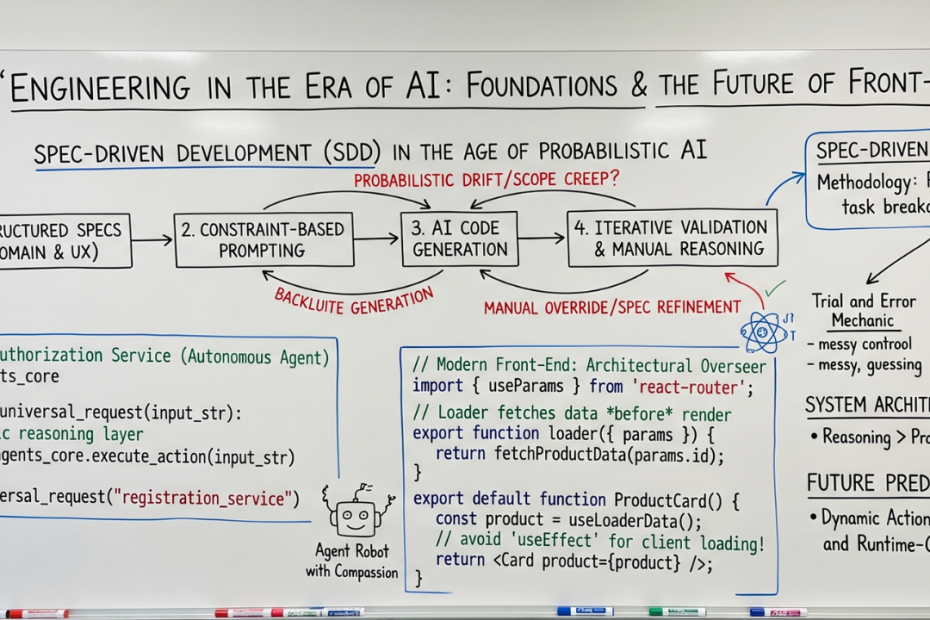
To mitigate this, many teams are shifting toward Spec-Driven Development (SDD), a specification-first engineering approach influenced by Domain-Driven Design (DDD) principles. In SDD, structural specifications, requirements, constraints, and task breakdowns are clearly defined before code generation begins, helping ensure that implementations remain aligned with business and technical objectives..
Even with an SDD approach where you break requirements down phase-by-phase, the probabilistic nature of AI means it can still flop on certain code blocks. You will still experience back-and-forth iteration loops. However, being ultra-specific radically improves the baseline output.
8. Conclusion
As AI agents evolve from autocomplete tools into autonomous software systems, the role of the engineer is undergoing a massive transformation. Writing syntax is no longer the primary value driver; system architecture, strict specification planning, and foundational evaluation are what guarantee secure, scalable products. To thrive in this new landscape, engineers must master the underlying core fundamentals to effectively direct the autonomous tools at their disposal.
Written by:
- Perete Harrison, DevOps, Software & AI Engineer
- Kehinde Adeyombo, Front-End Web Development Engineer
- Gideon Usani, Front-End Web Development Engineer